
Safety · Concept prototype
See how a building fills, and how it empties.
A visitor map already holds a building's corridors, shop fronts and public entrances. Crowd Flow Lab puts simulated people on one: a venue filling up in the morning, and the same crowd leaving in an emergency, with and without guidance.
Best on a laptop or a large screen. It runs in the browser and sends nothing anywhere.
- Status
- Concept prototype. Not a product yet.
- Built on
- The same map format our wayfinding uses.
- It is not
- A certified fire-safety study.
One crowd, two ways out.
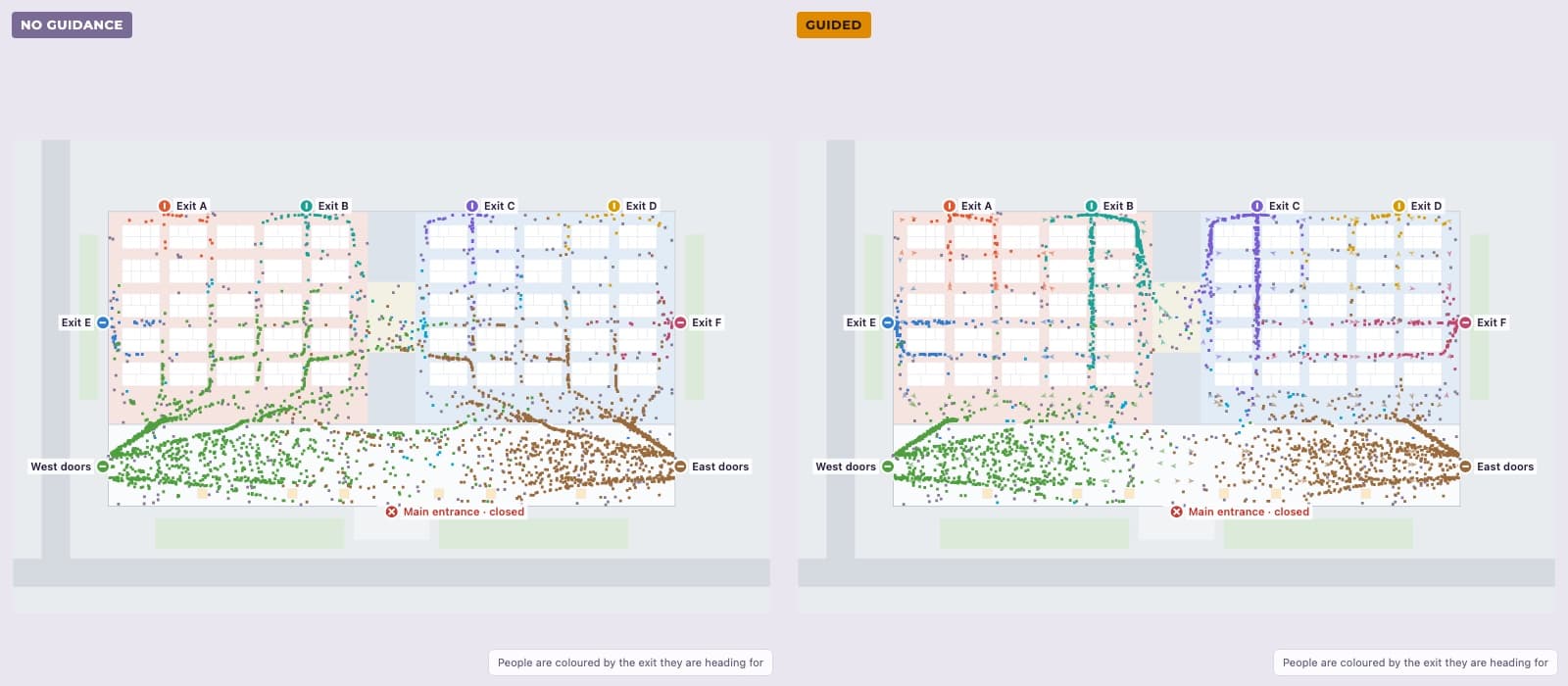
A fictional exhibition centre about a minute after the alarm, with the main entrance closed. Left: no guidance, and people head for the doors they came in through. Right: the guidance screens could give, using every exit. Each person is coloured by the exit they are heading for.
What runs today, and what is a direction.
Three different things. We keep them apart.
Runs today
The map and the routes
Interactive maps and routes on kiosks and phones run in buildings today. A visitor map already holds corridors, shop fronts and public entrances: a starting point for a crowd model, not all it needs.
Try it now
Crowd Flow Lab
A concept prototype in your browser. It puts simulated people on a building map and plays an ordinary morning and an emergency, with exits you can close.
Direction
Screens that guide people out
Kiosks and media screens that switch to evacuation directions and spread people across the exits. This is not built. We are looking for building teams to shape it with us.
What the lab shows.
Fill the venue, sound the alarm, read the result.
The morning
Doors open, people arrive, queue for badges, walk the floor and line up for food. You see where the crowd stands and how long the waits get.
The alarm
The same crowd leaves twice, side by side: once with no guidance, once guided to the exit with the shortest expected time. Close any exit and watch what changes.
The result
How long the building takes to clear, how many people were held in dense crowding, and how many are still inside at a deadline you set.
What it is not.
Read this before quoting a number from it.
- It is an illustration built on published crowd models. It has not been validated against the test cases fire engineers use.
- It uses only the ways out it finds on the visitor map, or ones you add. Emergency exits that are not on the map do not exist for it.
- It simulates people. It does not count, track or identify anyone in a real building.
- It reports exposure to dense crowding, never a casualty estimate.
- The demonstration venue is fictional. No real building is shown.